English
 Čeština
Romanesque Foundations | daily 10:00 a.m.–6:00 p.m.
THE MAGICAL LUXEMBOURGS – FRAGMENTS OF THE LIBRARY OF WENCESLAS IV (1361–1419)
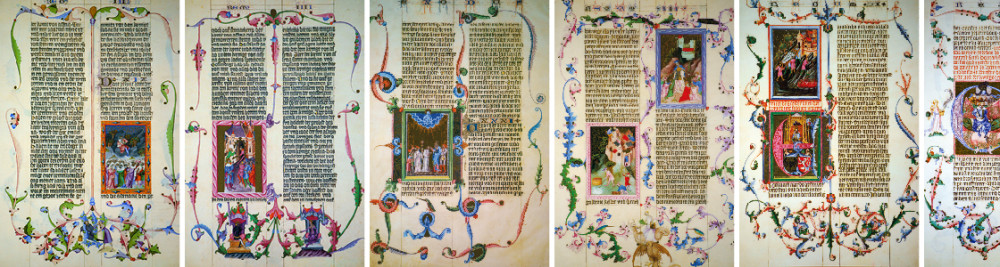
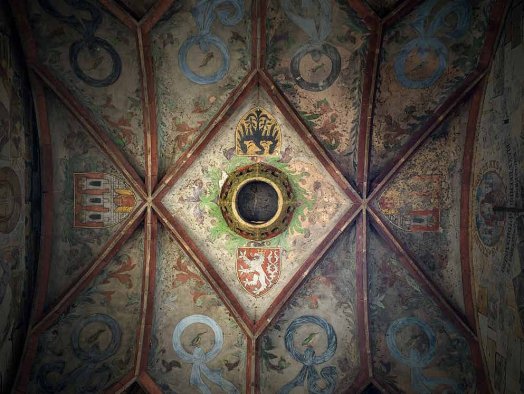
The exhibition of medieval book culture at the Minorite Monastery in Prague presents the Bible of Wenceslas IV, the Golden Bull of Charles IV, and 17 additional facsimiles of rare historical documents, offering a unique insight into the fascinating world of medieval manuscript production. Visitors will once again feel the spirit of history connected with the rule of the Luxembourg dynasty—enhanced by the authentic setting in which they themselves once resided. The connection between content and place intensifies the unique, almost magical atmosphere of the entire experience.
During their era, education in the Czech lands experienced unprecedented growth, especially under the reign of Charles IV, when Prague became the intellectual center of Central Europe. Visitors will be able to admire uniquely crafted facsimiles of old manuscripts, such as the Bible of Wenceslas IV, the Golden Bull of Charles IV, and 17 other important volumes from the library of Wenceslas IV, including the Velislav Bible and the Krumlov Picture Codex. Each of these books bears witness not only through its text but also through its rich illuminations.
A particularly interesting example is the Chronicle of Constance by Ulrich Richental, one of the most important sources on the Council of Constance. It describes key events and introduces both prominent and lesser-known participants of the council. Among other things, Richental’s work includes a gallery of coats of arms of individual participants as well as prices valid at the time of the council, demonstrating the author’s attention to everyday life in the city. From the perspective of royal iconography, the most notable work is Historia Plantarum, where one can admire a representative depiction of Wenceslas IV in the company of prince-electors. The Munich Astrological Miscellany of Wenceslas IV is the most remarkable of the three surviving astrological manuscripts. It contains works by Arabic and Jewish astrologers, including the Introductorium quod dicitur principium sapientiae by Abraham ibn Ezra, a free translation of the astronomer Albumasar, a treatise on the planets, and an unfinished star catalogue by al-Sufi with Ptolemaic tables. The Martyrologium of the monk Usuard is a calendar-like register of saints (originally martyrs), with brief biographical entries arranged by months and days of the year. In monasteries and chapters, daily readings from this book commemorated the anniversaries of saints’ deaths, understood as their birth into eternal life—including the Czech patron saints St. Wenceslas, St. Adalbert, and St. Procopius.
A manuscript fragment of The Book of the Marvels of the World by John of Mandeville contains a cycle of 28 full-page illuminations that originally accompanied a Czech translation of this popular medieval travelogue attributed to Mandeville, although the text itself has not survived. The paintings depict scenes from journeys from Europe through Constantinople, Palestine, and Egypt to distant parts of Asia. They were most likely created in Prague around 1410 within the circle of the court of Wenceslas IV, based on a Czech translation by Vavřinec of Březová. These and many other unique facsimiles of historical books from the Luxembourg period, associated with the mysticism of Wenceslas IV, will be on display at the Minorite Monastery in Prague from March to May. These facsimiles are highly accurate copies, virtually indistinguishable from the originals, making it possible to spread awareness of these volumes and bring the intellectual legacy of the Luxembourg rulers closer to the general public.